

You will have likely heard the term “pouring medium” used in acrylic pouring. Medium can mean a few different things in the art world, so today we’ll answer the question what is pouring medium and why do we use it?
Quick Links
For your convenience, here are store links to items we mentioned in this article.
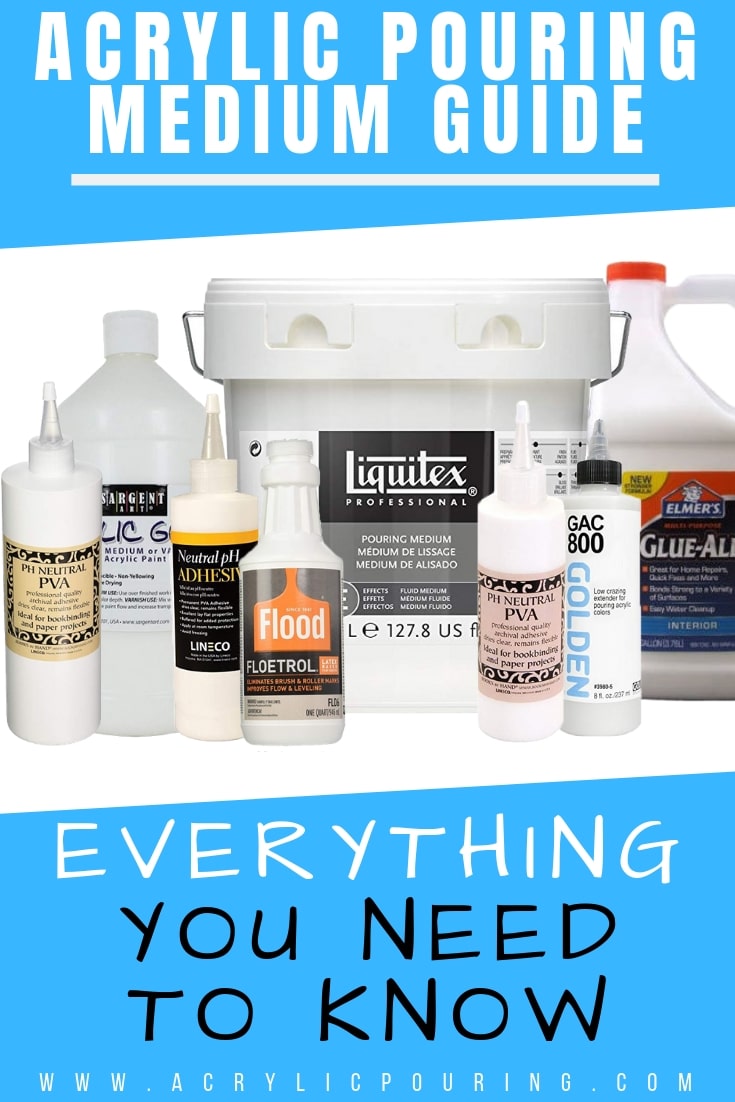
- Liquitex Pouring Medium: Best-known brand and highly preferred by painters
- GAC800: Designed to prevent or limit cracking and crazing
- Floetrol: Thins paints for use with spraying
- PVA Glue: Used by several popular YouTubers
- Elmer’s Glue All: Can be used as a very inexpensive pouring medium
- Book Binders Glue: A neutral PH alternative to the regular PVA glue
- Lineco 901: Suitable for archival paintings
- Sargent Art Gloss Medium: Dries so beautiful and glossy and much more economical
If you’ve spent any time reading blogs, about acrylic pouring or taken a look at YouTube videos of artists working, you’ll definitely recognize the term “pouring medium.”
Folks with art backgrounds may already know about mediums, but we know from personal experience that most newcomers have lots of questions about this topic. With that in mind, we wanted to address some of the most common questions, including the following:
What is a pouring medium?
Why do we use pouring mediums instead of just adding water?
Are all pouring mediums the same?
What are the best ones?
Should I stick to one or use several? And how do I choose?
Read on to find all the answers and to see the pouring mediums we recommend to artists of all levels!
What is a pouring medium?
A pouring medium is an additive used to make acrylic paints pour and flow smoothly and freely. Pouring medium acts as both a diluting agent and binder. Mediums give acrylic paint smoother flow and will help paints with a mix of colors to act more uniformly. They also improve the overall integrity of your paints, so that they dry and finish with cracking, separating, or fading. Essentially, a pouring medium makes acrylics easier to work with and much more suitable for the pouring techniques we love so much!
Why Don’t We Just Use Water?
Using water to thin your acrylics is a simple, easy and inexpensive way to make paint easier to work with when you’re pouring. When you’re trying to pour on a budget, water is a great medium to start out with.
However, using water does have major cons. Water will dilute your colors, meaning, the vibrancy of your paint will be lost when on the canvas. Water also dilutes the binding agents in your paints, which means that they won’t stick as well to canvas and won’t work well at all on tougher surfaces like driftwood.
Water can’t completely bind with paint, either, so it results in an uneven consistency when you start working with your thinned acrylics. With water, you may find that your paints flake and lift of the canvas when they dry. Layers won’t stick to each other either.
Overall, your paintings likely won’t have the same vibrancy or quality that they ought to. What’s more, even if they look great initially, this likely won’t last. Water affects the pigments, binders, and finish when dry.
A good pouring medium gives you the fluid dynamics you want from water-thinned paints while making sure the paint retains its integrity and vibrancy. When you use a pouring medium, you typically won’t need any water to make your paints flow the way you want.
Are all Pouring Mediums the Same?
There’s quite a range of pouring mediums out there for you to try! Mediums vary widely and while their primary purpose is to improve the fluid dynamic of your paints, they also serve some practical purposes.
You might add a glossy medium to change the way your piece looks when dry. Or, you might just stick with a standard medium and add a glossy sealant coat later on.
Most pouring mediums fall under the “all-purpose” category. In general, they’ll optimize the consistency, flow and binding of your paints. Floetrol and Liquitex are a great example of popular pouring mediums that are considered “all-purpose”.
This being said, there are some more specific products on the market that are intended for a specific purpose. These are mostly preservatives for adding longevity to archival pieces, or more visually oriented products such as a gloss medium.
Which Mediums are Best?
The “best medium” varies wildly from artist to artist, depending on a number of factors, including technique and paint brand.
Most Popular Mediums
Liquitex Pouring Medium
Liquitex Pouring Medium is one of the best-known brands in the art market. Liquitex is aimed specifically at artists, and has a great consistency and reputation for quality. Because of the demand for Liquitex Pouring Medium due to the rise in popularity of acrylic pouring, Liquitex has often found it difficult to keep up with production, which has resulted in a sharp increase in cost.
As acrylic pouring has become more popular, Liquitex has had trouble keeping up with demand. This product has often been out of stock. Artists are also reporting that prices have risen sharply because of the demand, as retailers realize that it’s become a very popular product.Click to check current prices
Because Liquitex is considered an “art” product, the price is higher than other mediums that you can find at a hardware store. Floetrol, considered a “contractor” product, is sold at a lower price and in larger quantities than it’s more expensive counterparts. If you’re pouring on a tight budget, you might want to opt for Floetrol instead of Liquitex.
Floetrol is a hardware store alternative to Liquitex, GAC800 (see below) and other “art” brand offerings. Floetrolis sold primarily as a paint extender for house painters, and thins paints for spraying as well as extending the drying time of your paint. Floetrol is totally inert when dry and has excellent longevity.
Opinions are varied when it comes to Liquitex vs Floetrol, but the answer to “which one is best” really comes down to you as an artist! Floetrol works well for beginners and intermediate artists, with many pourers using it as a standalone all-purpose pouring medium.
Additionally, you can use Floetrol as an additive along with one of the other all-purpose mediums, since it can promote the formation of cells. Many experience artists use Floetrol in conjunction with Liquitex for this specific purpose.
To learn more about Floetrol and see how to use it in practice, click here for a Floetrol pouring recipe.
GAC800
GAC800 is the Golden brand’s equivalent to Liquitex Pouring Medium. It’s especially designed for pouring techniques and artists like us. The Golden product is different from Liquitex in that it’s formulated to be used in a very high ration compared to paint: up to 10 parts GAC800 to 1 part fluid acrylic! Though many of us don’t work with ratios this extreme, it’s certainly worth it to try Golden’s GAC800 while you experiment. Like Liquitex, GAC800 will prevent or limit cracking and crazing and thick layers of paint.
Golden also has their own formula for pouring that includes GAC800 and alcohol (find it here).
Other Pouring Mediums
PVA Glueis a common glue that can be found in most art classrooms. It’s used and favored by many popular pouring artists, although opinions on it’s quality are varied. PVA Glue (also known as Elmer’s Glue All in the US) can be used to make a very inexpensive DIY pouring medium. PVA Glue does all the basics fairly well, and has all the binding ability you’d expect from an adhesive.
If you’re trying to be thrifty or you’re just starting out, this is a good way to experiment without investing much money. Having said that, you should know that this product is slightly acidic, and your resulting painting will not be “archival quality.” This is the primary reason why experienced and professional artists prefer a dedicated medium over glue.
Book Binders Glue is a neutral PH alternative to the regular PVA glue, and suitable for archival quality paintings as a result. If you like working with glue as opposed to a special pouring medium like Liquitex or Floetrol, this will help you keep doing so without sacrificing the longevity of your pieces.
Sargent Art Gloss Medium is a less well-known product which is part of the group of specialized mediums we mentioned earlier. Sargent Art Gloss Medium is an excellent clear coat for finishing pieces, but you can also mix in a splash along with an all-purpose medium to add some extra sheen to acrylics.
Lineco 901 is a product that helps to preserve acrylics for archival paintings, so it’s a good thing or add to pieces you’ll sell. With that said, Floetrol and Liquitex do a good job of preserving a piece’s integrity by themselves, but if you’re concerned about longevity, Lineco 901 is a great product for peace of mind.
Novaplex 233 – This product is offered by a small company in California. It’s a fairly popular and economical alternative to Liquitex. Shipping prices can be quite high, though. You’ll also have to deal with ordering directly from the company, since Novaplex isn’t sold on Amazon.
Note: This company also has a great range of paints! They’re a preferred brand of YouTube favorite artist Caren Goodrich.
On a side note, to complement your Acrylic Pours, I highly recommend using a Cricut Machine (my personal favourite is the Explore Air 2 machine) to design and print yourself beautiful crafts on all sort of supports. Check it out here! Now back to Pouring Medium.
DIY Pouring Medium
If you’d rather mix things up and make your own medium, you can do so fairly easily!
For example, if you aren’t completely happy with the results of Floetrol and Elmer’s Glue-All individually, it is possible to mix the two and create a custom medium to fit your needs better. For this recipe, you won’t need any water.
DIY Floetrol & Elmer’s Glue- All Recipe
- Always strain your glue-all and Floetrol through a mesh paint strainer before using them in pouring. It’s completely normal for lumps to form as these products settle, and does not mean that the product has “spoiled”. Straining will help you to avoid any unwanted texture.
- For this recipe, you’ll mix Floetrol and Glue-All at a ratio of 1 part Glue-All to 4 parts Floetrol. For example: if you’re using 3 oz sample cups to measure, you’ll want one 3 oz cup of Glue-All, and four 3 oz cups of Floetrol.
- Combine the two products and stir thoroughly. Make sure that they are well incorporated to avoid unwanted separation. Just like that, you’ve got your own homemade pouring medium!
- Medium can be stored for a period of time, but we find that up to a week is best.
How Much Pouring Medium To Use
The amount of pouring medium you need will depend greatly on your project, technique, and most of all, your paint.
If you’re using thicker paint like Liquitex Basics, you might need a bit more medium to get the right consistency. The typical ratio of Liquitex Basics to pouring medium is 1 part Liquitex to 3 parts medium (again, depending on your desired consistency).
If you’re using a thinner craft paint like Nicole’s Acrylics, you will need less medium to get to the consistency you’d like. Thin craft paints are typically mixed at an even ratio of one part paint to one part medium.
Should I Stick to One Medium? How do I Choose?
As you start your acrylic pouring journey, it’s a great idea to experiment with a range of different mediums. You’ll want to use paints from different brands to find your favorite colors, and you’ll want to play with a range of pouring mediums for the same reason! Eventually, you’ll find on that clicks with you and your process.
Most experienced pour painters will have their favorite product or favorite paint “recipe” and will usually not deviate from it. That’s because they can be sure (as much as one can be) of getting a repeatable and consistent result when they pour.
Our advice to you: start with whatever medium is available to you logistically or what’s within your budget, and test it out with your favorite brands of paints to see if you like the results. Try a few of your own side-by-side comparisons and see if the premium products work better and are worth the extra investment.
You probably don’t want to use more than two pouring mediums or additives, as a general rule. For example, most people use an all-purpose medium (such as Liquitex or Floetrol) and then a more specific additive, like the Sargent Art Gloss to give a shiny finish or some silicone oil for better cells.
Overwhelmed by Options? Let us break it down:
For beginners on a tight budget: PVA glue, such as Elmer’s.
For the average beginner or intermediate artist: Floetrol.
For a professional artist looking for a great well-rounded all-purpose medium: Floetrol, GAC800, or Liquitex Pouring Medium.
A Note on Costs
Many of these mediums, and others are available on Amazon. We’ve made a handy comparison page which lists many of the common choices. Included are Floetrol, GAC800, Liquitex Pouring Medium, gloss mediums from Sax and Sargent Art, PVA glue, bookbinders glue, and more.
Why Pouring Mediums Are a Good Idea
A good pouring medium gives you the fluid dynamics you want from water-thinned paints while making sure the paint retains its integrity and vibrancy When you use a pouring medium, you won’t need much (if any) water to make your paints flow the way you want.
There are a number of advantages to working with these additives. Pouring mediums actually bind to the paints, unlike water. There’s no separation or weakening. In fact, many mediums can strengthen paints and prevent cracking/crazing!
Mediums don’t sacrifice color, either. As long as you stick to reasonable ratios of paint to medium, you should see results with very satisfying color depth. A pouring medium may also extend the drying time of the paint, making it easier to work on your painting for a longer time or to create faux finishes. You get a valuable window to perfect your cells, finish up the edges of your canvas, and do any last-minute tweaks!
Wrapping Up
We hope we’ve answered all your questions about pouring mediums! They can be a confusing subject for many beginners, but they’ll make your pours much easier to work with and your results that much better. Let us know if you think we’ve missed something! Feel free to share in the comments about your favorite pouring mediums or any differences you’ve observed working with these products.
Happy pouring!
FAQs
How do I make pouring medium?
To make your own pouring medium, you will need the following ingredients:
2 parts white glue, such as Elmer’s glue
1 part water
1 part acrylic medium, such as gloss medium or fluid matte medium
To make the pouring medium, simply mix the ingredients together in a container until they are well combined. You can adjust the ratios of the ingredients as needed to achieve the desired consistency.
Is pouring medium the same as fabric medium?
Pouring medium and fabric medium are similar, but they are not the same. Pouring medium is specifically designed for use in acrylic pouring techniques, where it helps the paint to flow more easily and creates cells and other interesting effects. Fabric medium, on the other hand, is used to thin acrylic paint for use on fabric, and helps the paint to adhere to the fabric and maintain its flexibility. While you can use pouring medium on fabric, it may not provide the same results as using a dedicated fabric medium.
How do I use acrylic pouring medium?
To use acrylic pouring medium, simply mix it into your acrylic paint according to the desired ratio. A common ratio for pouring medium and acrylic paint is 1 part pouring medium to 3 parts acrylic paint. Once the pouring medium is mixed into the paint, you can proceed with your acrylic pour as usual. You can experiment with different ratios of pouring medium to paint to achieve different effects in your acrylic pour paintings.

After being told in high school that she was so bad at art that she should switch to another subject, Deby didn’t paint again for 35 years. Then a stroke released a new wave of creativity and she began exploring with dot painting, abstract and eventually acrylic pouring, and at last the joy of working with color returned. You don’t need ‘talent’ to be an acrylic pouring artist – just enthusiasm, some basic instruction, and a willingness to try, fail and try again. Paint along with her and learn from her many mistakes, and you’ll soon make great art together.