
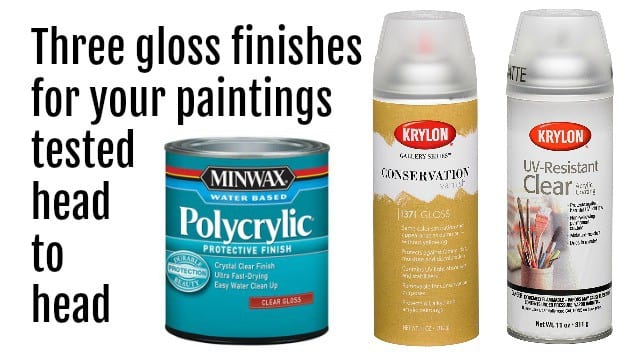
You know I love my Polycrylic. I talk about it all the time, and I even wrote an article some time back about why it is my favorite finish for acrylic paintings. But there are always more finishes to try and today I’ll give a couple of spray finishes a try.

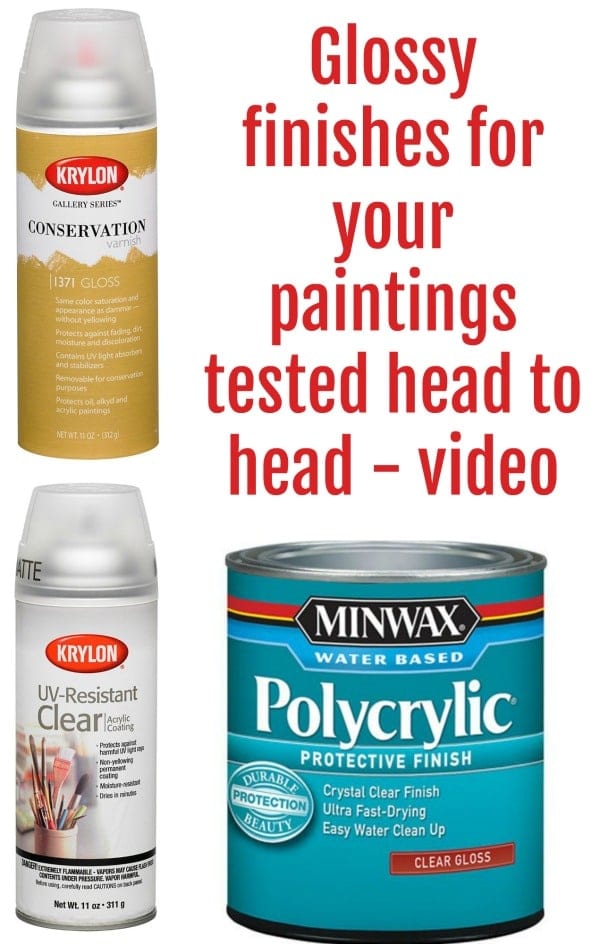
I love the thicky glossy finish I get on my paintings with the Polycrylic, but I see people in the group using all sorts of things to bring back the color and gloss to their dried paintings, so a trip to the art section of my local stationary store produced these two possible candidates. I picked both because of their UV protection, something not offered by my usual finish, but valuable to have in a sunny climate here in the Caribbean.
Krylon Conservation Varnish
Krylon UV-Resistant Clear Gloss
Despite being almost $30 a can here in Cayman, these both sell for less than $10 on Amazon. Ouch, I feel taken advantage of but that’s no surprise here in Cayman.
Both have all of the usual warnings and precautions that you would expect to find on spray paints such as using them in well-ventilated areas, not breathing the fumes, not to use while smoking etc. I chose to spray mine outside which was a bit inconvenient but better to be safe than sorry.
Further recommended reading:
I tested these two sprays on some painted tiles with my usual Polycrylic as a comparison. I gave each 2 coats of the spray. Each of the tiles was cleaned before I sprayed, using the same method I would usually use for the Polycrylic Finish. Check out the video to see my results and how each one performed.
So there you have it. Both were very different. The UV-Resistant Clear really didn’t look glossy at all. Even after two coats I could barely tell there was anything on there at all except it looked like it was covered in a fine mist. Each and every tiny spray particle was visible. Maybe I didn’t spray it liberally enough for each coat, but the can did say that multiple thin coats were recommended. It did, however, look much better after just one coat of the Polycrylic, two coats would be even better.
The Conservation Varnish was strange. The first coat was fine, smooth and glossy and after just one coat I was already impressed. Then the second coat separated really badly leaving a bumpy finish as if it were reacting with silicone in the painting, even though the first coat had dried smooth. I just didn’t understand that at all. The second test I did revealed more where the first two thin coats were just fine, very smooth and glossy, but when I tried to add a thicker final 3rd coating, it gave that separated and bumpy surface again. Clearly, this varnish doesn’t like being applied too thickly.
Conclusion: I like the added benefits of the UV Protection that both sprays provide. The Conservation varnish gives a super glossy finish and I like it a lot, but you have to be careful to only use thin coats or you’ll get that separation. The UV-Resistant Clear isn’t so glossy and shows every fine particle from the spray, like a mist, but that does improve with a coat of my regular finish over the top. I think I would use that one again – two coats of the UV Resistant and then two coats of the Polycrylic to get the benefits of each.

After being told in high school that she was so bad at art that she should switch to another subject, Deby didn’t paint again for 35 years. Then a stroke released a new wave of creativity and she began exploring with dot painting, abstract and eventually acrylic pouring, and at last the joy of working with color returned. You don’t need ‘talent’ to be an acrylic pouring artist – just enthusiasm, some basic instruction, and a willingness to try, fail and try again. Paint along with her and learn from her many mistakes, and you’ll soon make great art together.