
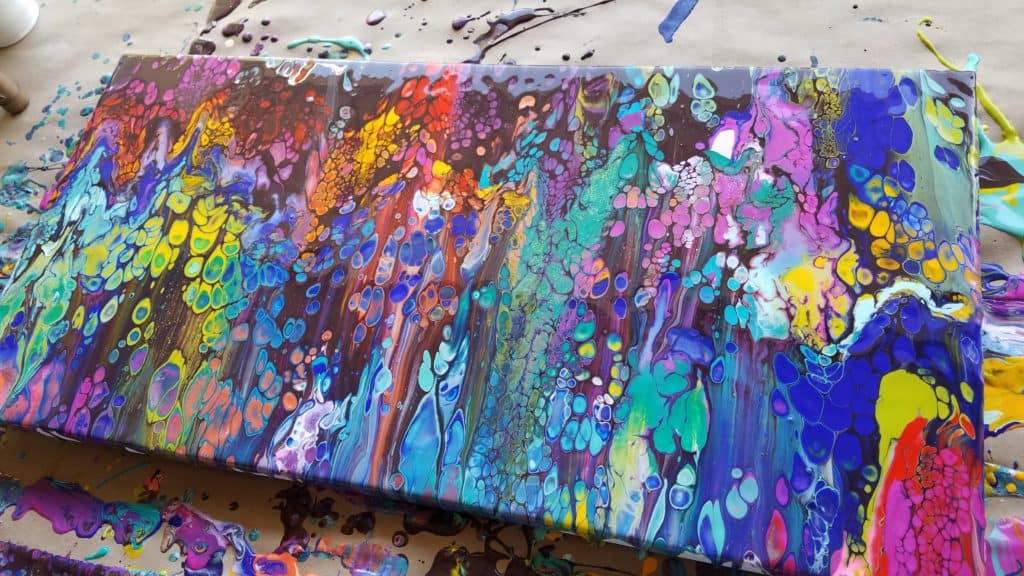
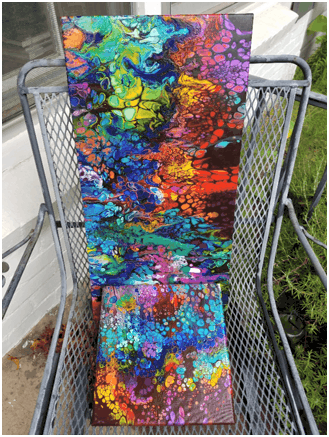
I have attempted a swipe painting on several occasions, and every time I failed miserably. My consistency was off, I applied too much pressure, I missed areas and would have to re-swipe… something always happened. And so… I pretty much quit trying.
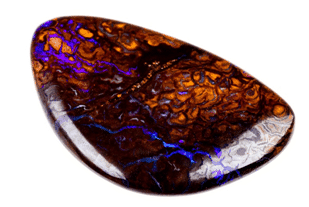
I reluctantly decided to give swiping another go on this painting. I was inspired by the colors in boulder opals, and swiping seemed perfect because it allows more control over color placement than a dirty pour or flip cup. I had to try it even though I was almost positive it would go the way it usually does (bad). Well, guess what… I finally did it! A successful swipe!
This surprise success got me thinking about all the pour fails I have experienced, so I impulsively decided to show some of them at the start of this video. I hope that sharing these will inspire others to keep learning and keep trying! Fails are inevitable and they make success so much sweeter.
Supplies I Used:
- 12” x 24” stretched canvas (and 10” x 10” for test swipe)
- Pebeo Studio Acrylics (see colors in directions)
- Liquitex Pouring Medium
- Golden GAC 800
- Thinning solution (pouring medium mixed with water in a 1:3 ratio)
- Treadmill Silicone Oil
- Kitchen Scale
- Kitchen torch with butane
- Level
- Paper towels
- Cups/storage containers
- Painter’s Tape
- Large Tupperware to cover painting
- Rubber gloves and rubber apron
- Large tongue depressors
Before I attempted the bigger swipe, I did a 10” x 10” test-swipe to see how the colors worked. I was over-the-moon happy with the results of the test, so I did not change a thing! The final mix included 14 colors: blue-tinted white, purple-tinted white, quinacridone scarlet, iridescent orange-yellow, azo pink, violet, hansa yellow, diarylide yellow, ultramarine blue, green-yellow, iridescent green blue, turquoise, teal, and terra rosa. I also included several colors of glitter mixed with Liquitex pouring medium.
If you saw my blackbird inspired pour post you will know that I am pretty systematic about paint mixing. I use a three to one ratio of paint to pouring medium and I measure everything on a kitchen scale. For pouring medium, I used half Liquitex Pouring Medium and half GAC 800. For example, if I used three ounces of violet paint, I used one ounce total of pouring medium (.5 ounces Liquitex and .5 ounces GAC 800) in that color. I try to be careful and stir slowly.
After that, I thinned out the paint with a solution made of pouring medium and water in a one to three ratio. I add small amounts until the mixture is the correct consistency. My mixture for this painting was like warm honey (a bit thinner than my primary recipe).
Immediately prior to laying down the colors, I added one drop of treadmill silicone oil to each ounce of prepared paint.
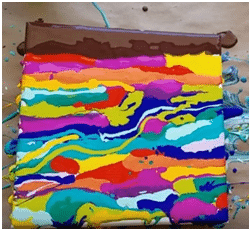
Using a popsicle stick, I laid down lines and patches of color, using all the colors except terra rosa. I covered the entire painting in these patches, except for the top two inches or so along the 24” side. I covered that remaining area with the swipe color—terra rosa mixed with a bit of black to make a warm dark brown.
I was not quite sure what to use as the swiper in this swipe! I decided to go with a long piece of damp paper towel. This turned out to be a risky choice as you can see in the video! To do the swipe, I placed the paper towel on the terra rosa very lightly and then slowly pulled the brown across all the lines and patches of color.
The paper towel was torn at the end, and it left a stripe of un-swiped paint smack down through the center of the piece! I had to fix it by re-swiping the center and another area on the corner. This was nerve-wracking, but amazingly it worked out okay!
After the swipe, I used a kitchen torch to warm up the paint and encourage cell formation. I kept the torch 6”-8” above the painting and moved fast so I did not burn the paint. I decided to do just a bit of tilting at the end to get a more pleasing composition. To make sure the painting dried slowly, I placed it under a large Tupperware which reduces airflow and helps retain humidity.
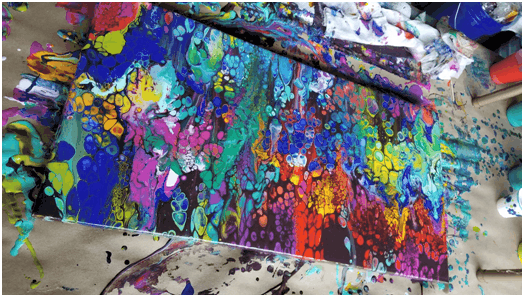
The control over color placement the swipe technique allows was perfect for this boulder opal inspired painting. I am so glad I decided to give swiping another try!

Jenny Post discovered acrylic pouring in April 2017 and uses the therapeutic process to help manage the highs and lows of bipolar disorder and work-related stress. She enjoys sharing with and learning from the acrylic pouring community. You can check out her work on YouTube, Instagram, Facebook, and Etsy.