
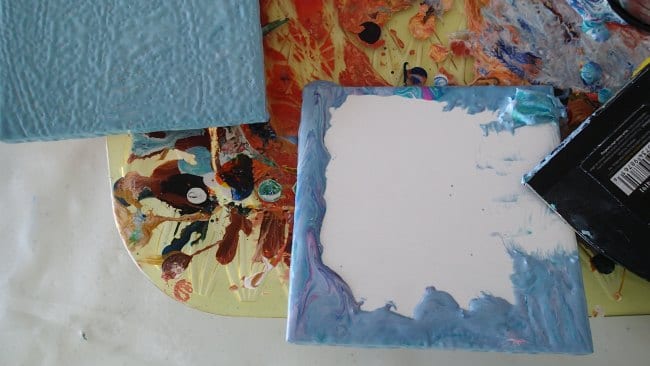
Just what do you do with the spilled paint that falls off the sides of your projects, or over the edges when you tilt? That depends. If there is enough of it and the colors look nice, you can try to dip a mini canvas, some small tiles or Yupo paper and make a little project to match your big one. But if there isn’t much paint or the colors are muddy or well mixed then let me show you what I do with mine.
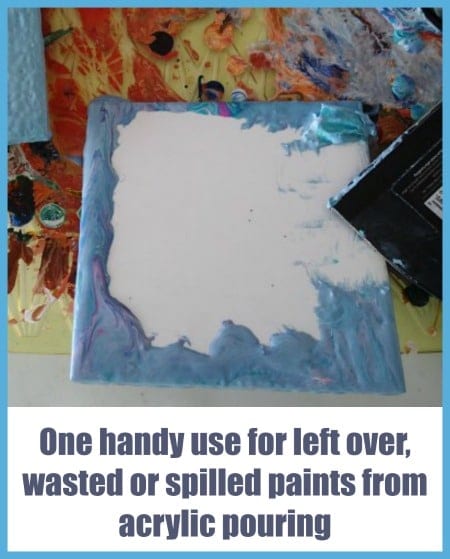
I trial a lot of my pours onto ceramic tiles. Small, easy to clean, affordable. Cleaning them off if the trial or experiment fails right away is easy while the paint is wet, but what about when it’s dry. Then it can be very difficult to remove. I have tried repouring over the original but the new layer of paint causes the original paint to come away from the glossy surface and bubble or buckle and fold. Which gave me this idea.
I use my leftover paint spills to paint over old projects and loosen that paint so that it pulls or scrapes right off, a quick wipe and a rinse and there I am with a brand new clean tile to paint on again. Check out how it works in the video below. Anytime you have some stubborn paint to remove, try softening it with your waste paint and see if that helps.
What do you think? Do you have any other smart ideas for how to use up the spilled paint that isn’t necessarily enough or pretty enough to create a mini project? I’d love to know. I don’t like to waste anything!

After being told in high school that she was so bad at art that she should switch to another subject, Deby didn’t paint again for 35 years. Then a stroke released a new wave of creativity and she began exploring with dot painting, abstract and eventually acrylic pouring, and at last the joy of working with color returned. You don’t need ‘talent’ to be an acrylic pouring artist – just enthusiasm, some basic instruction, and a willingness to try, fail and try again. Paint along with her and learn from her many mistakes, and you’ll soon make great art together.