
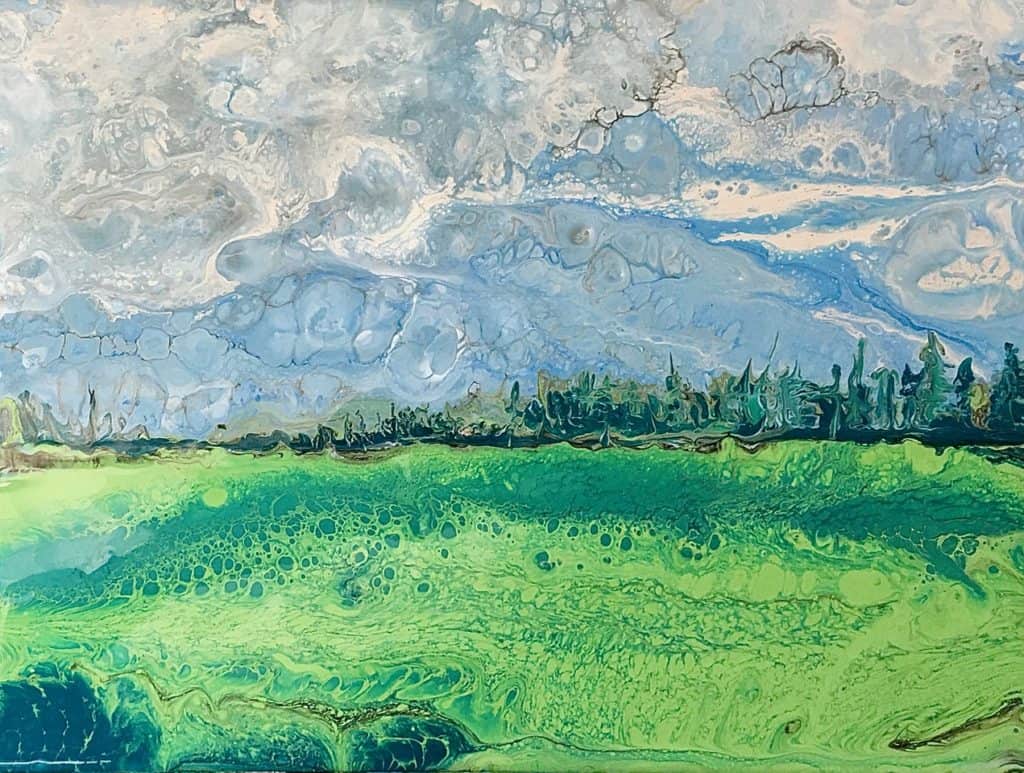
Thank you for staying with me over the last few weeks. All of the experimentation, research, note taking, and determination has paid off. The painting you see above is the vision I had in my head when I started this project. My goal was to figure out how to use acrylic pouring techniques to create paintings that retain the beautiful unpredictability of a pour, but at the same time be recognizable as a landscape. In this video it all seems to come together. I’m almost embarrassed to tell you how proud I am of this painting. I understand if you aren’t crazy about it. Perhaps you were imagining a different type of poured landscape. I’m thrilled because creating a landscape like the one above is exactly what I set out to do.
I’m also happy because the advice that I routinely give to my students actually worked for me as well.
If you have an idea, see it through—Don’t Give Up.
Your paintbrush (pencil) is not a magic wand. You have to put the work in.
Learn from other artists and keep an open mind.
Learn from your failures and your successes. Keep what works and avoid things what didn’t.
Although there is always an element that is out of your control when you pour paint, I wouldn’t say I got lucky with this painting. I believe the stage was set for success because of all the work that was done before the painting was made. My experience from the last several paintings allowed me to create this landscape and hopefully several more.
Please watch the video to see exactly how I did it. Meanwhile, here are a few things that pop into mind.
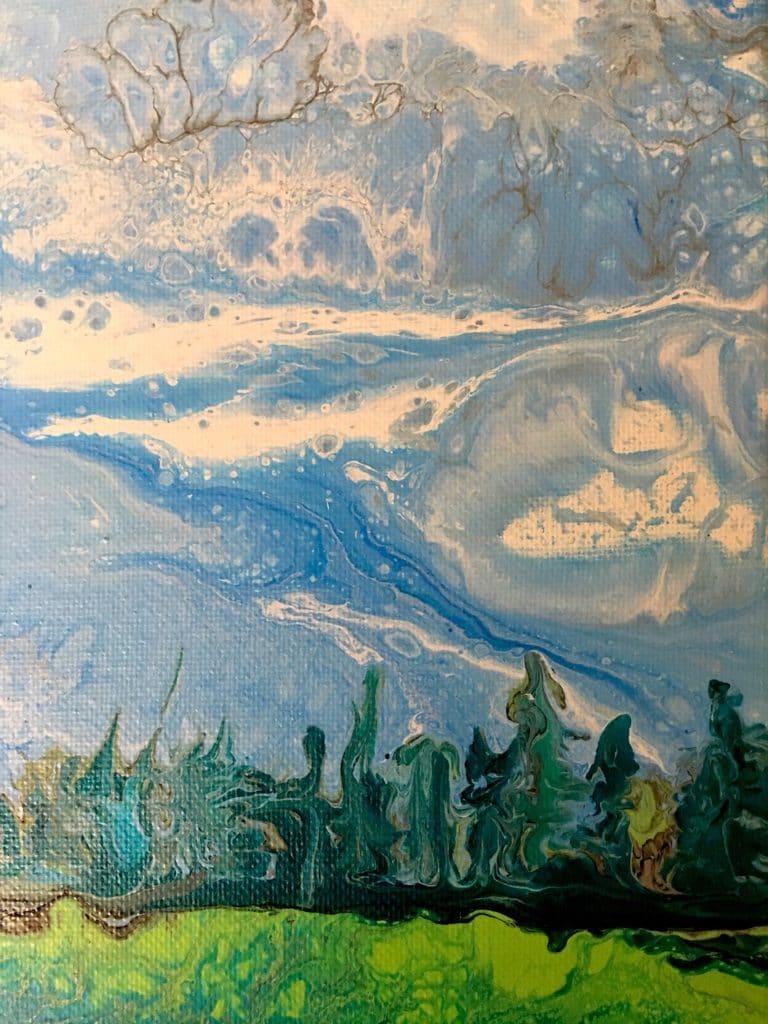
After watching a wonderful video on Youtube from Gina DeLuca called “Landscape / Ocean with Cloudy Effect” I decided to tape off the ground area and then use a straight pour with tilting to create the sky. For the ground area I removed the tape and used the “puddle, line swipe technique” that had worked in the last painting. One of the things I really wanted in this painting was a strong horizon line. I discovered that a paint drenched string would not do the trick. I really thought the string would work, but it didn’t. Instead I used a squirt bottle of black paint to add the horizon line. Finally I added green paint along the horizon line and pushed it around with a craft stick to create the illusion of trees.
I still have a lot to learn about poured landscapes but this feels like a very good starting point to begin fine tuning my landscape pouring techniques. For now I plan to sit back and enjoy my success for a few minutes—before I unwrap another canvas.
Detail of the poured landscape:

Steve Shaw is an artist and teacher living in Atlanta, Georgia. His days are spent in the classroom teaching his students the basics of art and self-expression. In the evenings and weekends, he paints. Steve has shown his work in several galleries in the Southeast and has illustrated three children’s books. Recently Steve has discovered acrylic pour painting and is putting all his other projects on hold while he journeys down this artistic road.
To see more, follow him on Instagram, visit his website, watch his videos on his YouTube Channel and purchase his paintings at Etsy.com.